Scaled-Down Multi-Vehicle Cooperative Decision-Making Experimental Platform
This project presents a scaled-down physical vehicle experimental platform designed to validate multi-vehicle cooperative decision-making algorithms, achieving a cyber-physical closed loop characterized by centralized perception and decision-making alongside distributed low-level execution. Built upon the Robot Operating System (ROS), the hardware architecture consists of an Ackermann wheeled robot cluster, a central decision server acting as an edge computing node, and a structured physical testbed equipped with high-precision localization. The overarching system architecture highly aligns with the advanced development trend of “Vehicle-Road-Cloud” integration in intelligent transportation, providing an ideal testing environment for evaluating the effectiveness of cutting-edge reinforcement learning algorithms under real-world physical constraints.


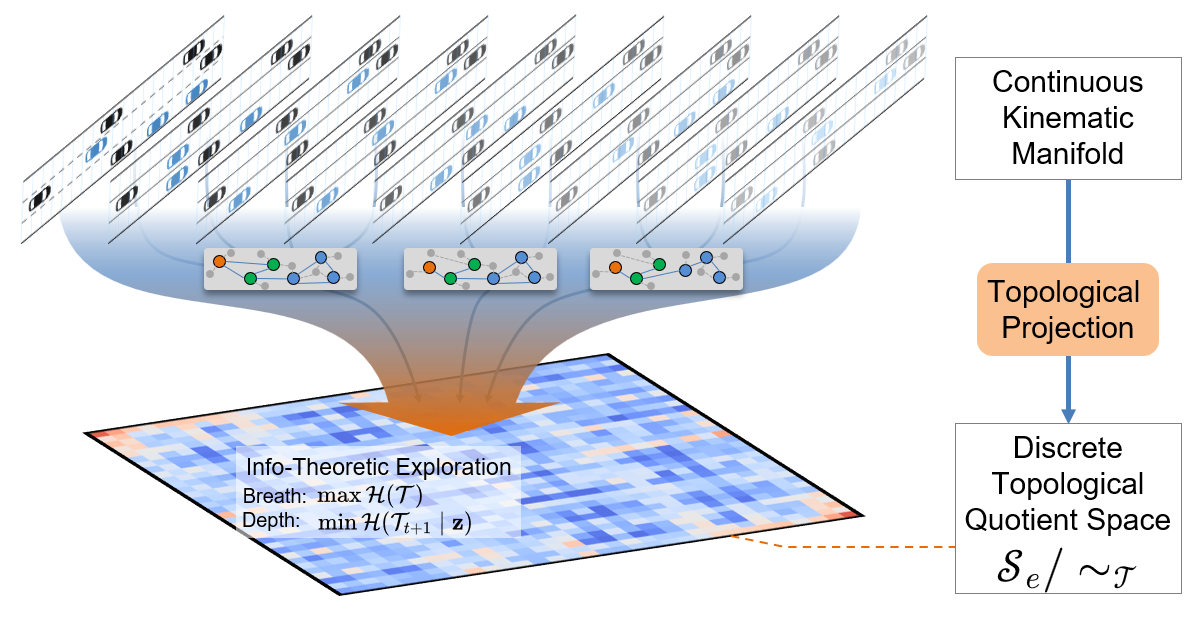
In terms of experimental design, this project focuses on the classic “zipper merge” conflict scenario, which features high game-theoretic complexity, to test the algorithm’s capability in resolving conflicts between individual optimums and collective swarm efficiency. To bridge the “Sim-to-Real” gap from pure virtual simulation to physical world deployment, the software system innovatively introduces an adjoint state projection mechanism, resolving perception overlaps and safety hazards caused by the continuity of lane-changing maneuvers in physical space. Concurrently, the low-level controllers fully account for communication latency, sensor noise, and authentic vehicle dynamics constraints, ensuring that high-level semantic decisions are executed precisely and smoothly by the robots.

Physical experimental results demonstrate that the vehicle cluster, driven by the core cooperative algorithm, successfully exhibits proactive, high-level emergent intelligent behaviors in reality. In comparative tests, this cooperative strategy not only induces vehicles to yield proactively to create global lane-changing gaps but also significantly reduces the total system task time, achieving substantial cooperative efficiency gains. System performance monitoring further reveals that the trajectory tracking error during physical execution is minimal, and the end-to-end decision latency falls well below control cycle requirements, fully proving the engineering feasibility and robust stability of this multi-agent decision-making architecture for real-world intelligent transportation system deployments.

References
2026
-
preprint
 arXiv preprint, 2026