Multi-Vehicle Cooperative Decision-Making in Stochastic Mixed Traffic Segments
My PhD Research
My doctoral research centers on multi-vehicle cooperative decision-making in mixed traffic. I developed an integrated multi-agent decision-making framework to address the coordination of high-dimensional vehicle interactions under stochastic environments. The framework is organized around 4 interconnected methodological pillars: reward shaping, search optimization, interactive representation, and topological exploration. These methodological advances are complemented by closed-loop validation in a cyber-physical scaled-vehicle testbed.
Problem Setting: The problem is formulated in continuous roadway segments characterized by two key features: stochastic traffic conditions and mixed traffic composed of CAVs and hHDVs. Stochasticity arises from random vehicle inflows, varying initial and target lanes, and heterogeneous destination requirements. Mixed traffic introduces interactions between controllable CAVs and HDVs whose behaviors are only partially observable and cannot be directly controlled. The resulting decision problem is therefore to coordinate a group of CAVs to improve traffic efficiency and safety under uncertain traffic conditions and heterogeneous, partially controllable interactions.

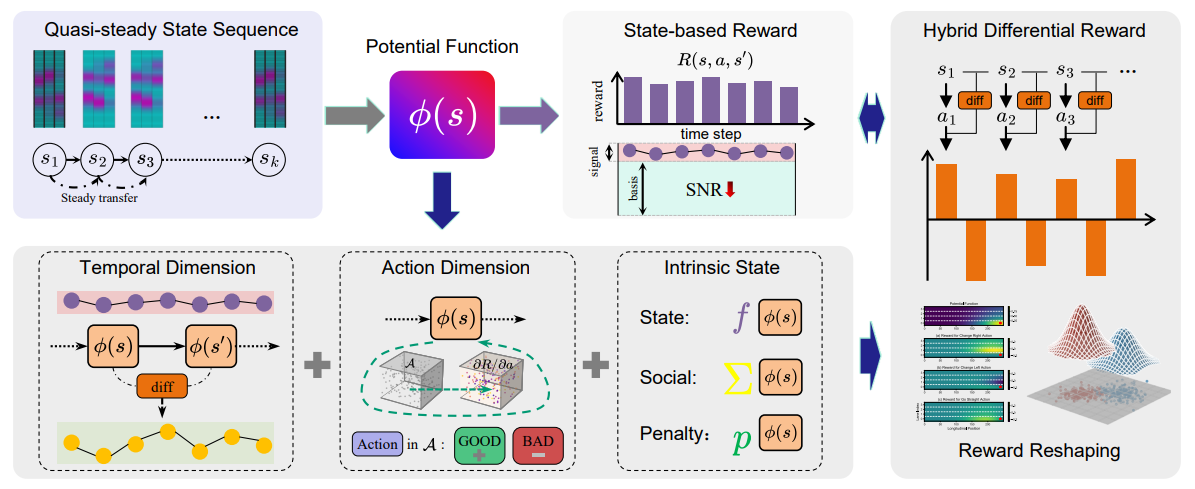
Hybrid Differential Reward (HDR): To address reward sparsity and credit-assignment challenges arising from high-frequency control in continuous environments, I developed the HDR reward-shaping mechanism. HDR combines the temporal variation of state potentials with the marginal contributions of individual actions to provide more informative learning signals. The resulting reward structure preserves optimal-policy invariance while substantially improving the discriminability of the reward landscape, accelerating MARL convergence in high-frequency decision-making settings. (Han et al., 2026)

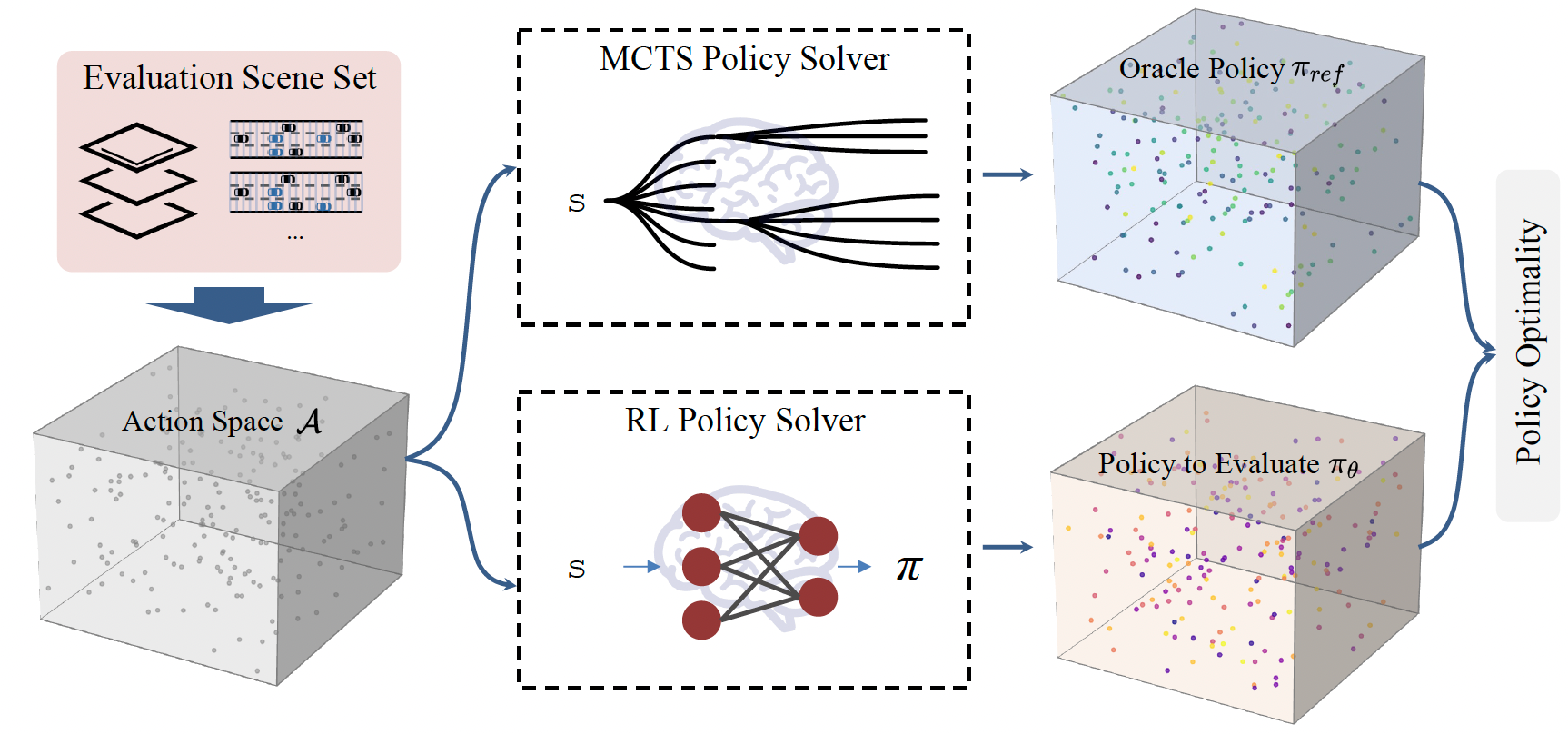
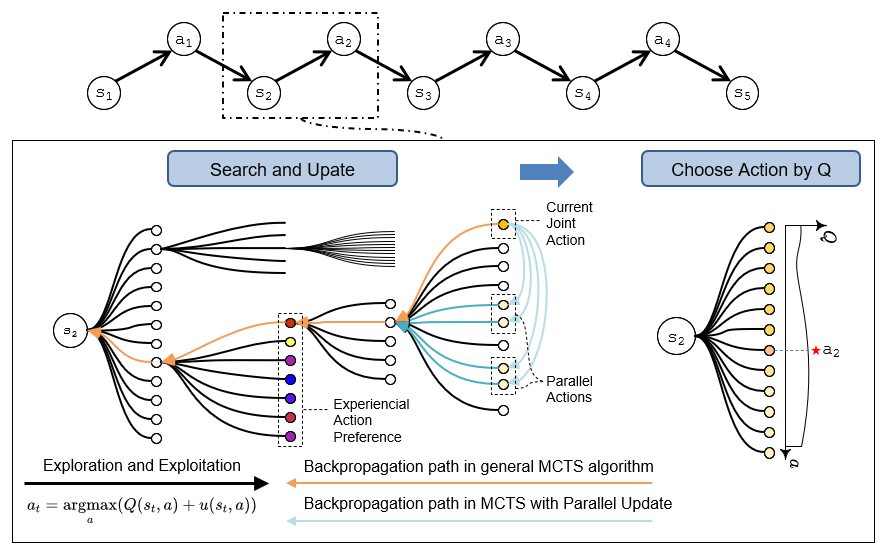
Parallel Update MCTS: To address the combinatorial growth of the joint-action space $\mathcal{O}(\mathcal{A}^N)$ in multi-agent coordination, I developed the PE-MCTS algorithm. By analyzing the “safety short-board” effect in vehicular interactions, PE-MCTS introduces safety-similarity-based soft action pruning and a Parallel-update mechanism, together with Experiential-preference-guided expansion. The resulting search procedure provides an asymptotically optimal, non-myopic decision oracle for high-dimensional coordination, offering a quantitative performance reference against which real-time learned policies can be evaluated. (Han et al., 2025; Han et al., 2026)

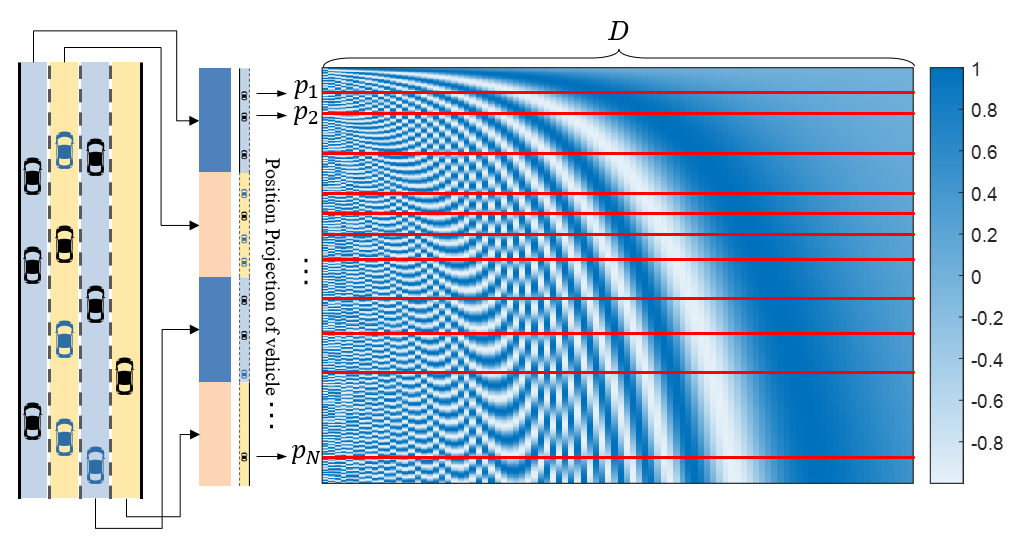
Spatiotemporal Representation Network (RepNet): To capture dynamic and non-Euclidean interactions among vehicles, I designed RepNet, an encoder-only architecture inspired by the ViT. RepNet tokenizes spatiotemporal traffic-state representations with physical position encodings and employs global multi-head self-attention to capture dependencies across the multi-agent traffic topology. It transforms variable-length and heterogeneous traffic states into fixed-dimensional, decision-oriented embeddings that can be directly integrated with downstream policy networks. (Han et al., 2024)

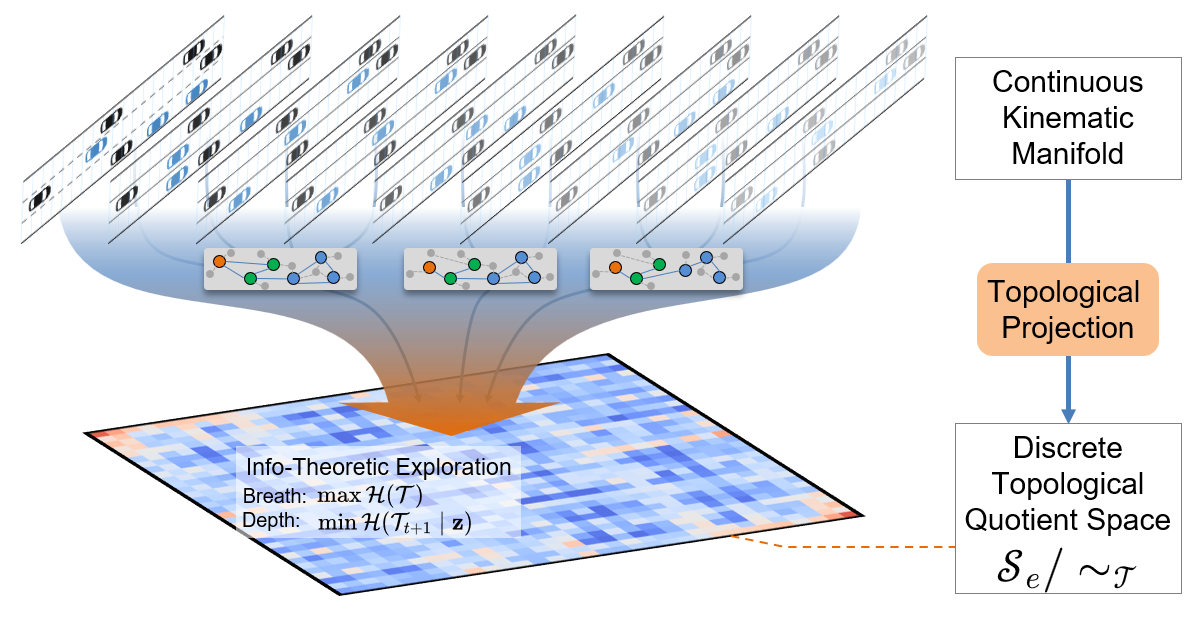
Topology-Enhanced Exploration: To overcome the limitations of blind trial-and-error in strong game-theoretic environments, I proposed the TPE framework. It utilizes locality-sensitive hashing to project continuous kinematic manifolds into discrete topological quotient spaces, ensuring game-equivalence via MCTS oracle policy. By incorporating information-theoretic measures such as conditional mutual information gain, TPE converts largely random exploration into a structured process of topology-guided information discovery, leading to more robust and cooperative multi-agent policies. (Han et al., 2026)

Cyber-Physical Validation: To bridge the gap between algorithms and physical deployment, I led the development of a multi-agent scaled-vehicle testbed. The platform implements and experimentally validates an edge-cloud architecture, with centralized, high-dimensional decision-making performed at the roadside/cloud level and distributed execution at the vehicle level. Physical experiments further demonstrated the robustness of the proposed game-theoretic decision-making methods under practical engineering constraints, including V2X communication latency, actuator delays, and positioning noise.

References
2026
-
preprint
-
preprint
 arXiv preprint, 2026
2025
-
IEEE T-ITS
 IEEE Transactions on Intelligent Transportation Systems, 2025
2024
-
IEEE ITSC
 In IEEE International Conference on Intelligent Transportation Systems, 2024